
Undergraduate Research Intern
Supervisor: Prof. Tapan Mukerji
Subsurface Energy Systems · Deep Learning
I am an undergraduate student majoring in Geophysics at the University of Science and Technology of China (USTC), expecting to graduate in June 2027.
At USTC, I conduct research in the Computational Interpretation Group under the supervision of Prof. Xinming Wu. My work focuses on deep learning for seismic data.
I am also an Undergraduate Research Intern at the Stanford Center for Earth Resources Forecasting (SCERF), working with Prof. Tapan Mukerji on geomodeling and forward modeling.
I plan to pursue a Ph.D. and am broadly interested in Artificial Intelligence and Subsurface Energy Systems.
Gave an oral presentation on Geo‑VAE at IMAGE 2026 in Houston.
Joined Stanford SCERF as an Undergraduate Research Intern.
Joined the Computational Interpretation Group at USTC.
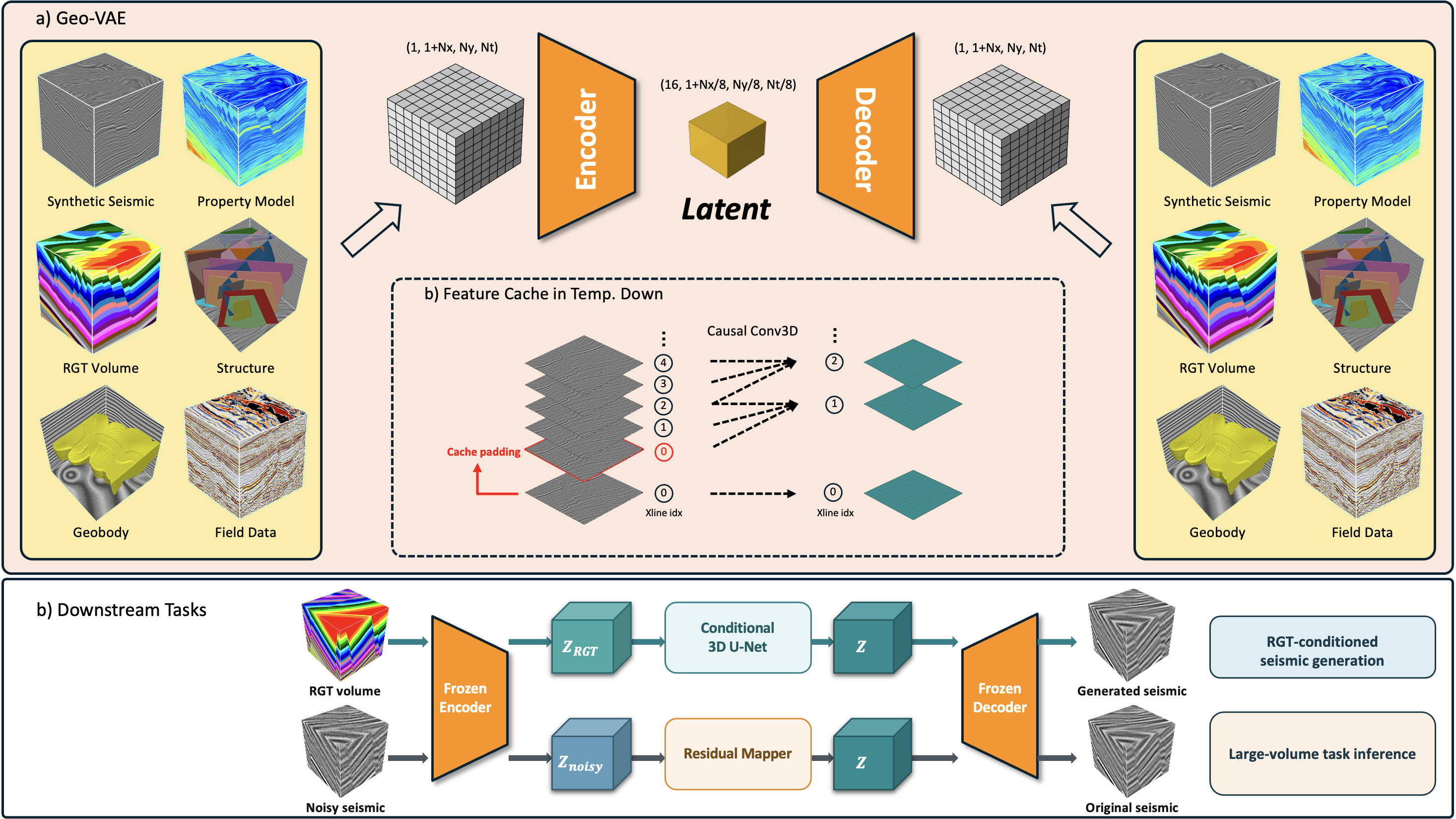
Geo‑VAE adapts the pretrained Wan‑VAE to map seismic, impedance, RGT, fault masks, and field seismic into a compact latent domain. Cached causal resampling treats crossline as a pseudo-temporal sequence, yielding isotropic 8×8×8 downsampling and 31:1 scalar compression for 256³ cubes.
Across 128³–512³ cubes, it maintains competitive, modality-dependent reconstruction fidelity and reduces latency versus fine-tuned Wan‑VAE at larger volumes. The latent interface supports RGT-conditioned seismic generation and complete-volume 768³ latent denoising.
Degradation-representation learning for robust suppression of random noise, acquisition footprints, and migration artifacts in 3D seismic data. [Code]
A 2.5D full-image U-Net emulator mapping global physical ocean fields to coupled biogeochemical variables, with evaluation under anomalous ocean-climate conditions. Manuscript in preparation.
An automated pipeline aligning GNSS TEC-derived ionospheric phase with NISAR dual-frequency InSAR for high-resolution super-resolution research.
Undergraduate Research Intern
Supervisor: Prof. Tapan Mukerji
Undergraduate Researcher
Supervisor: Prof. Xinming Wu
B.S. Candidate in Geophysics, School of the Gifted Young